Dies ist ein Überblick über Virtual Desktop Infrastructure (VDI), NComputing und ASTER.
Massive Umstellung auf Cloud Diensten
Überall auf der Welt spricht man über die Umstellung auf Cloud-Dienste wie Cloud Computing und virtuelle Desktops. Viele glauben, dass die meisten Probleme einfach durch die Migration in die Cloud gelöst werden können. Dabei wirft die technische Seite in der Regel keine Fragen auf. Die Hauptbedenken beziehen sich auf die Kosten der Lösung. Finanziers interessieren sich für den Cashflow und den Zeitpunkt des Return on Investment. Es ist jedoch wichtig, das richtige Cloud-Modell zu wählen und gleichzeitig die Nutzung der vorhandenen IT-Infrastruktur zu optimieren.

Warum gibt es einen Hype um Cloud Computing?
Finden wir es heraus. Warum ist externes Computing in der Wolke so vorteilhaft für Unternehmen?
Zunächst einmal sollten wir verstehen, was Cloud Computing ist. Cloud-Computing-Dienste ermöglichen es, große Datenmengen und sehr rechenintensive Aufgaben von den vorhandenen Computern des Unternehmens zur Verarbeitung in externe Rechenzentren – die Clouds – zu verlagern. Der Nutzer erhält über seinen Computer Zugang zu den Cloud-Diensten. Die Vorteile der Dienste sind:
- Keine Notwendigkeit, GPU-Karten zu kaufen und eigene Computer aufzurüsten
- Schnelle Bereitstellung von Rechenaufgaben mit hoher Belastung in der Cloud
- Schnelle und einfache Skalierung des Umfangs der Rechenaufgaben nach oben oder unten
- Clouds bieten sichere Datenspeicherung mit RAID-Systemen und für die GPU-Verarbeitung werden nur zertifizierte GPUs und gekühlte Serverräume verwendet
Warum gibt es einen Hype um Virtual Desktop (VD)-Dienste?
Immer mehr Unternehmen nutzen Virtual Desktop Services. Es ist leicht zu verstehen, dass dieser Dienst mit der Bereitstellung von virtuellen Desktops für Kunden verbunden ist. Warum ist dieser Dienst so populär geworden? Er verwendet ein Client-Server-Computing-Modell. Da Cloud-Unternehmen über viele Server verfügen, bieten sie in der Regel VD-Dienste an. Wenn alle Berechnungen auf dem Serversystem durchgeführt werden, ist der Umfang der Berechnungen auf dem Client-System gering. Für kleine Aufgaben auf der Client-Seite sind Computer mit geringer Leistung besser geeignet. Solche Computer werden als Thin Clients oder Terminals bezeichnet. Der Benutzer meldet sich mit seinem Thin Client und einer leichtgewichtigen Thin Client Software beim Server an. Nach erfolgreicher Authentifizierung am Server sieht der Benutzer seinen Desktop auf seinem Bildschirm. Dieser Desktop wird als virtueller Desktop bezeichnet, da er virtuell auf dem Server erstellt wird. Der Thin Client zeigt lediglich den Desktop an. Daher wird die gesamte IT-Infrastruktur für die Bereitstellung von Cloud Computing als Virtual Desktop Infrastructure (VDI) bezeichnet, und die Computer auf der Client-Seite werden als VDI-Thin Clients bezeichnet. Thin-Client-Computing und VDI-Dienste sind aufgrund der günstigen Kosten von VDI-Diensten und der Reduzierung der Kosten sehr beliebt geworden:
- TCO: low cost of thin client computers, reduction of SW licenses costs, etc.
- lower electricity consumption
- lower expense on maintenance of IT-infrastructure
VDI Effectiveness
VDI optimization is not just about saving money by moving to the cloud, but also maximizing the use of existing IT infrastructure. The transition to cloud computing leads to the fact that traditional personal computers have become unused. Effective usage of old computers could improve the cost-effectiveness of VDI.
How can old PCs be useful in VDI?
You can use the existing computers of companies as thin clients. On one hand, their capabilities are broader than those of simple thin clients — they can also perform local tasks, which makes the transition to cloud technologies smoother and more manageable. On the other hand, there are additional energy costs, more workspace is required, and higher costs for maintenance. We will describe later how it is possible to use some parts of old PCs in VDI.
How is VDI organized based on Microsoft Products?
Microsoft provides a cloud platform called Azure. All computers in the Azure cloud use Windows Server Operating System (OS) while the thin clients use Windows OS. In 2021, Microsoft had a plan to release a specialized Windows OS version for old computers. The sole purpose of the OS was to make the old computers work as thin clients. On Windows (OS), there is a standard protocol for accessing Windows Server called the Remote Desktop Protocol (RDP). The thin clients are made specially to work through RDP are called RDP thin clients.
VDI organized with Ncomputing thin clients
An example of a thin client is an NComputing thin client. VDI with the NComputing products based on Windows Virtual Desktop solutions. The advantage of the NComputing solution is that they support different partners’ DaaS (desktop as a service) and SaaS (software as a service) solutions. The solution simplifies the transition to VDI like Citrix Workspace, Igel Cloud, and Stratodesk NoTouch Center. In the case of the transition to VDI with NComputing devices — old computers become unnecessary. Therefore, old computers become e-waste as it is necessary to buy new NComputing thin clients.
Is there an alternative to the thin client model?
The alternative to a thin client is a zero client. While a traditional thin client is streamlined for multi-protocol client-server communication, a zero client performs only data transition through a highly tuned onboard processor specifically designed for one protocol (PCoIP, HDX, RemoteFX, DDP). A device with such simple functionality has less demand for complex hardware or silicon and therefore becomes less prone to obsolescence. Another key benefit of the zero client model is its lightweight firmware represents an ultra-small attack surface, making it more secure than a thin client. Furthermore, the local firmware is so simple that it requires very little to no setup or ongoing administration. It’s the ultimate in desktop simplification, with the trade-off of flexibility. Most mainstream zero clients are specialized for one communication protocol only. Zero clients are less complex and cheaper than thin clients.
VDI organized with software zero clients
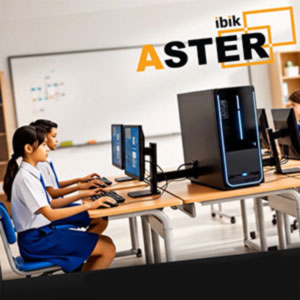
An alternative to the NComputing approach is using the old computers with a multi-user access program called ASTER. ASTER program allows creating up to 12 workplaces based on a single PC with a Windows 7/8/10 and Windows Server 2016/2019 (supported on Pro licenses only) operating system. The workplaces are ASTER’s zero clients. The single Windows PC is an ASTER’s thick client. Thick clients have the ASTER program installed. The zero clients are connected to the thick client via video cable, USB cable, or wirelessly. In this case, a zero client device consists of a monitor, keyboard and a mouse additionally it can consists of a web camera and headphones with a microphone as well depending on the use case. The thick client price is the price of a single standalone desktop, all necessary ASTER licenses plus additional graphic cards (if required). The desktop is the main part of the thick client cost. It is even possible to use an old computer desktop as the desktop of the thick client. The zero client price is the price of all necessary zero client hardware (monitor, keyboard, mouse, web camera, headphones, video cable, USB cable, and USB hub). We can get the hardware from the thick client as well as the zero clients from the unused old computers.
Comparison of VDI
From the table results, we could say that VDI organized with ASTER is a very good alternative to VDI organized with NComputing devices.
What are the advantages of VDI organized with ASTER?
The main advantage of the usage of ASTER is based multiseat PC (so-called on-site cloud) is that it reduces the budget required and helps to further use of the company’s old IT infrastructure. In detail it will allow:
- reducing the complexity of network administration (ASTER zero clients connect to the ASTER thick client just through video cables and USB extenders)
- improving VDI cost-efficiency by using old desktops as the thick clients
- saving on hardware purchases of new computers (some of the abandoned PCs can be used in the „cold reserve“ mode for use in temporary projects)
- additionally, reducing the total cost of ownership (TCO) by reducing the cost of maintenance, upgrades and repair.
- reducing electricity consumption (only by saving electricity, the cost of an ASTER license per workplace pays off in less than six months)
- increasing the security of the system in comparison with ordinary computers. ASTER workplaces contain only monitors, mice, and keyboards, and access to the disk is regulated by the Microsoft account settings. Thus, has fewer points of attack in security and privacy
- organizing a wireless thin-client/wireless zero clients is possible by using the Windows Wireless Display Adapter.
- using it as a home personal cloud or private cloud and organizing a home thin client system for remote work during a pandemic
- improving VDI cost-efficiency by utilizing old hardware (mice, monitors, keyboards, headphones, web cameras, etc.) for the zero clients
- reducing the cost of purchasing licenses that are tied to the processor under the license agreement.
The effectiveness of ASTER zero clients is confirmed by sales of over 30 thousand ASTER licenses. The major sales regions for ASTER are the USA, EU, China, India, and Brazil.
Use VDI with zero clients of ASTER.
Are you interested in using ASTER for organizing VDI in your organization?